


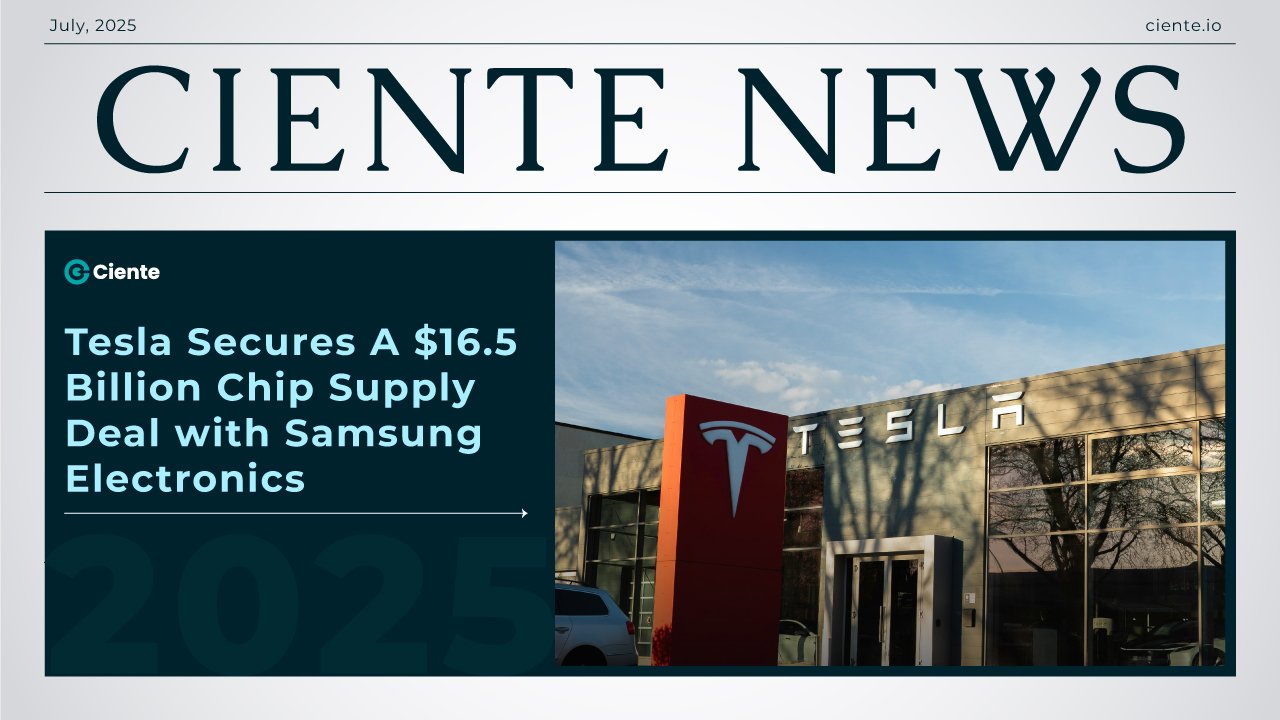
Is Tesla’s partnership with Samsung a calculated move to leverage the benefits of a domestic fab without the ownership headaches?
Recently, US-based businesses have witnessed a steady influx of funding in hopes of ensuring a consistent stream of AI chips within the country itself. And positioning the US as self-sufficient in substantial AI chip manufacturing.
Samsung agreeing to produce Tesla’s next-gen AI16 chips in Texas is a step in this direction.
On July 28, 2025, Tesla and Samsung shook hands on a $16.5 billion, multi-year contract that extends until 2033. The deal centers on manufacturing Tesla’s AI16 chips at Samsung’s Taylor, its fabrication plant in Texas.
Despite prior emphasis on domestic fabrication partnerships, this marks a fundamental shift.
AI chips are strategic assets, whether in a commercial or security context. And given ever-present geopolitical tensions, the risks of relying on other countries are substantially high, from TSMC to China.
And with Tesla captivated with vertical integration, domestic manufacturing is the most likely choice. It offers the US-based company more advantages:
- Quicker iteration cycles, i.e., from design to deployment.
- Control over IP and optimization procedures.
- Maintain centralized talent within its own hub.
- Localize critical manufacturing.
What could be Tesla’s underlying driver?
Musk’s vision behind this collaboration is to maximize production efficiency, states The Guardian.
Samsung’s GAA transistor tech at 2nm is popularly known as the holy grail of production and performance. This is what Tesla is zeroing in on.
Samsung has had a consistent head start on this tech over its rivals, such as TSMC, affording Tesla a strategic edge. Especially against its competitors that continue to rely on older nodes. The South Korean powerhouse can help deliver Tesla’s vision efficiently and rapidly.
And that’s the underlying goal.
It’s not merely a partnership. But as Musk chimed in, “Tesla is optimizing efficiency at the fab.” They are a production partner, which expands co-design capabilities for both.
Tesla is fulfilling its mission to develop AI and autonomy chips on US soil.
Technically, it isn’t backing off from domestic manufacturing, but rerouting to strategic leveraging. One that helps maintain leadership involvement and chip production in the US, strengthening its supply chain resilience.
And what does it mean for Samsung?
For Samsung, it’s an attempt to catch up with TSMC.
According to a South Korean analyst, the Taylor plant in Texas has had no potential customers. It resulted in Samsung postponing the delivery of chip-making equipment. What would they do with the resources when they had no projects in hand?
For Samsung, this is a significant win after cutting its $3.6 million worth of losses to the foundry business in the first half of 2025. This partnership is its attempt to bounce back.
And catching up to its rival, TSMC.
The future of this partnership: A synergistic proposition.
Tesla has always known to iterate faster than its competing chipmakers. Meanwhile, Samsung has been popular for being more efficient and responsive to its non-traditional clients.
Samsung proves to be a perfect proxy for Tesla as opposed to the US company running its own fab, which is too capital-intensive and far outside its domain, for now.
And with faster prototype-to-production cycles and design freedom, Samsung’s nod serves as support for Tesla’s experimental vision coming to life.