


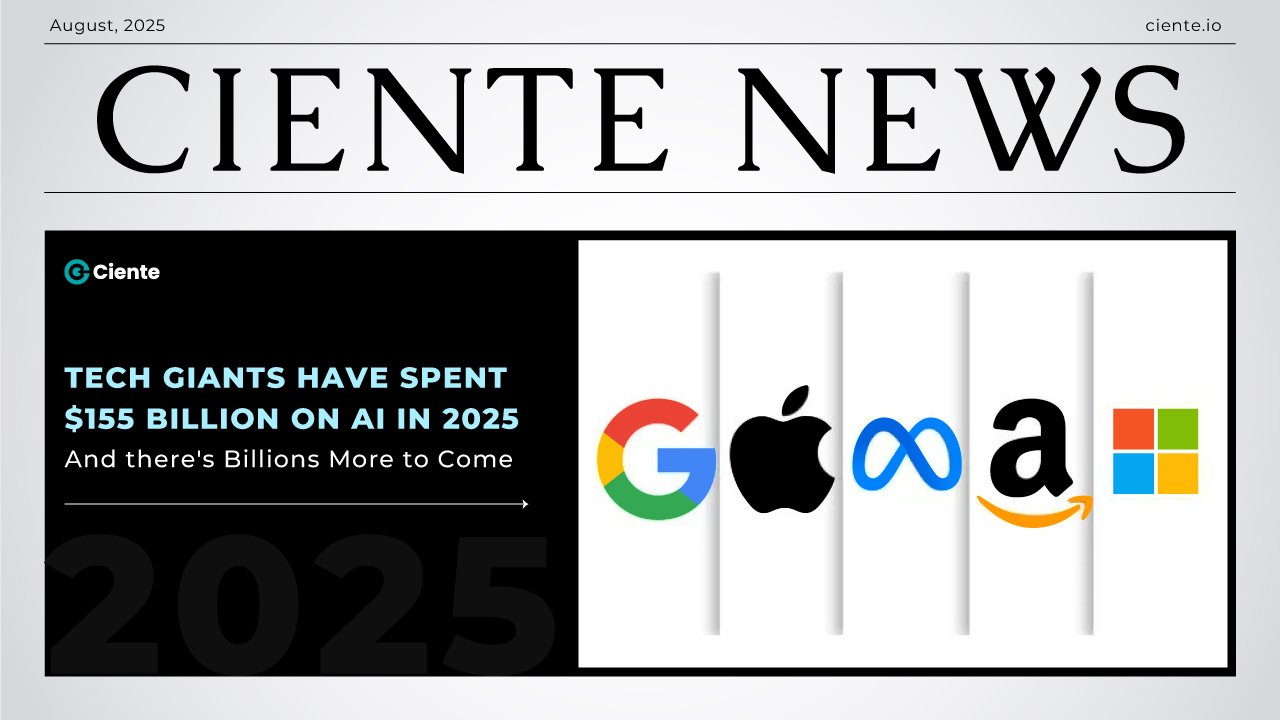
Silicon Valley’s key players are amping up their games as they attempt to one-up each other. The byproduct? $400 billion of capex by the end of the year.
The Guardian reports that, in total, all the tech giants have spent over $155 billion on artificial intelligence in a single year. More than the US govt. has spent on employment, education, and training altogether.
Recently, all the tech companies, from Alphabet to Google, reported their year-to-date capital expenditure. And most of it went towards data centers and other physical infrastructure, such as the establishment of AI servers.
The physical equipment, including power, semiconductor chips, and water, required to set up significant AI infrastructure necessitates extensive investments.
And even Google agrees. A large amount of its capital expenditure this year was directed towards AI data center development. Meanwhile, Meta reported $30.7 billion year-to-date expenditure and Alphabet reported $30 billion in the latest quarter for the current fiscal year.
Whether it’s Google, Alphabet, or Microsoft, their gargantuan investments are an opportunity. Whether it’s an opportunity to win the AI race or an innovation-driven future remains unclear.
And in the upcoming segment of the year, the capital expenditure is only set to balloon enormously. According to the Wall Street Journal, the total capital spent would amount to $400 billion.
But there’s a severe disjuncture.
Have shiny investments, experimental, and numerous iterations of GenAI models come to define innovation?
Is it complicated tech that serves only the society’s cream? At least this is what the tech business leaders and investors deem so.
How are AI chatbots, such as ChatGPT, meant to empower communities that lack access to the Internet itself? Google Gemini and ChatGPT might be acclaimed as “the” technology, but they lack significance for those with scarce internet bandwidth. It’s irrelevant.
How can these AI models be the technology of our times when they empower only some, and already add to the existing opportunities?
This digital gap is a reality: those with access to powerful tech and those who lack internet connection.
The definition of innovation has quite parted from what it genuinely means. It includes lobbying for good, but is now replaced with being investment-driven. Innovation traditionally entails low-cost tech that helps solve day-to-day business and life problems.
Meanwhile, one can sit in their households and only strategize how to fuel innovation from the very heart of their communities. Innovation today emerges from high-rise $1 billion buildings in the US and London.
As the billion-dollar investments continue to escalate, there are two roads the tech giants could take:
Either they democratize AI across every household, kickstarting the advent of superintelligence, like Zuckerberg plans to. But this will be accompanied by privacy concerns.
Or they continue to develop tech that remains accessible to a majority of the human race. And continues to establish users as passive recipients as the eccentric billionaires continue to make a competition, instead of strategic collaboration.