
Here’s the privacy-first alternative to ChatGPT and Gemini. Is Proton reaching too far with Lumos’s design, or will it prove a stealthy competitor?
Since the dawn of an AI-first landscape, security and privacy have become a focal concern. These two were omnipresent across Internet-centric discussions.
But AI’s dominance has skyrocketed the worries. And the skepticism persists.
Are tech companies using user data to train their models or sharing it with third parties?
The speculations have also turned into conspiracy theories. There are echoes that these businesses are turning over the collated user data to government bodies.
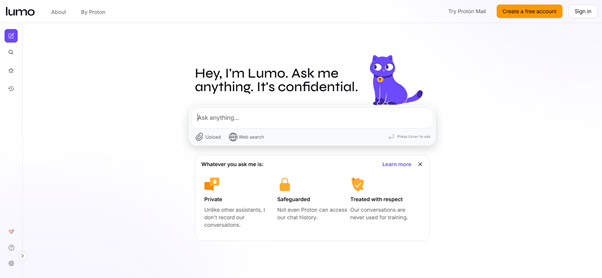
Proton, the company that launched the encrypted email services, is also introducing a privacy-focused AI chatbot called Lumo. The underlying modalities of this model aim to preserve user privacy through zero-access encryption.
Source: Proton
This zero-access encryption-based AI model will allow users to use an encryption key if they wish to access their own content. And also store all digital files locally. This way, even Proton doesn’t have access to user content, offering users a lucrative space to conduct their research.
But there’s also an added function. Lumo does have the ability to scour the web, at least on privacy-friendly websites. But it isn’t the default feature. Users can enable it, but even then, Lumo focuses on retaining that privacy as much as possible.
So, if you upload files, it’ll help you analyze them, but not save them on the back-end. To further ensure security, users can link the chatbot to Proton Drive. And this will warrant end-to-end encryption with the chatbot.
Overall, Lumos is run by LLMs that operate on Proton’s servers. This way, the chatbot can seek requests through the model that best suits the input query.
For Proton, Lumo isn’t just an alternative for the big tech AI models. But a strategic channel to prioritize people over profits, asserts Andy Yen, Proton’s Founder and CEO.